





SERVICES

Course Content


  • 17 lectures

  • 30h Duration

  • This Module introduces various aspects of Pipeline Stress Analysis, starting with a comparison of Piping and Pipeline which highlights the main differences. The approach towards Pipeline Stress Analysis is different and must be well understood.
  • Pipelines and their failures
  • Difference between Piping and Pipeline stress analysis
  • Pipeline fittings
  • Introduction of Pipe-Soil interaction
  • Restrained and Unrestrained sections
  • Water hammer effects on Pipeline
  • Introduction to Seismic wave propagation
  • Pipeline buckling, soil liquefaction, etc.

  • This Course is useful for all engineers who wish to make their basics clear in Pipe stress analysis. If you wish to "Experience" the "Stress Concept" and not only understand it mathematically or in bookish language, and most importantly if you possess patience and passion for the subject, then this Course is for you. This Course is divided into 3 videos. In these Courses we will discuss:
  • The concepts of Displacement Field, Stress & Strain Field
  • Modulus of Elasticity and its significance
  • What is 'Tensor'? Stress as a Tensor
  • Longitudinal stress, Radial stress, circumferential (Hoop) stress
  • Moment of Inertia
  • Stress-strain curve and practical approach

  • This Course is continuation of Course-1 and hence applicable for all Mechanical and Production engineers irrespective of their experience. This Course is highly recommended for undergraduates, fresh graduates, piping engineers, site engineers, and stress engineers. We go a little deeper into concepts like:
  • 3D state of stress
  • Mohr's circle
  • Theories of Failures
  • Maximum Shear Stress Theory
  • Von Mises theory
  • Importance of stress analysis
  • Also, a simple problem is solved by hand calculations to calculate the stresses in the system. The intention of this Course is to make the participant look at the problem without taking help of software.

  • A highly recommended Course for all stress and piping engineers. There are various codes based on their applications. For example, ASME B31.1 is for Power Piping, B31.3 is for Process Piping, B31.4 is for Liquid Hydrocarbon transportation etc. It is like "learning languages very close to each other". If you know one language and its grammar well, then it is simple to grasp other languages. Unfortunately, most Piping engineers do not read the code carefully. Some read the code but cannot interpret it. The equations provided in the codes are followed as is. However, all these equations are closely related to basic stress concepts and engineering theories learned in schools and universities. If an engineer understands why code equations are written in a particular way, they can relate them to new challenging problems and understand the code clearly.
  • Primary stresses and their characteristics
  • Secondary stresses and their characteristics
  • Occasional stresses and their characteristics
  • Which type of stress is more critical
  • Mode of failure of each type

  • This Course is continuation of previous Course and hence must be heard after completing Course 3. This talks about the code equations in detail.
  • Why equations are written in a particular way
  • What is the significance of + and - sign?
  • What is 'stress range'?
  • Stress relaxation
  • Self-springing of material
  • What are liberal stresses
  • Scope and Exclusions of ASME B31.3
  • Primary stresses equation and its allowable
  • Secondary stresses equation and its allowable
  • Occasional stress equation and its allowable

  • Defining the load cases is very important in pipe stress analysis as it is a relation between the software and the code requirements. Defining right load cases and understanding the mathematics behind the load cases is very essential. Most of the time it has been observed that engineers copy the load cases or try to learn them by heart.
  • How to write load cases and their nomenclature
  • There are various methods of combination such as scalar algebraic
  • Also, it answers critical questions like 'why a particular load case is written in a particular way?'
  • How to write the load cases using CAESAR II software
  • Different types of load cases
  • How allowable stresses are understood by the software when calling a particular load case by name
  • How to write load cases when a spring is introduced in the system
  • How to write load cases when a force is present in the system
  • This model also relates the load cases with the code equations. This Course is extremely useful for engineers with less than 5 years of experience who wish to understand the mathematics and the 'Why' behind the load cases.

  • Today's world is software driven. Engineers are no exception. Engineers often cannot give solutions without using software, so knowing the advantages and limitations of the tool is essential. CAESAR II is one of the finest stress analysis software using beam elements.
  • Basic elements
  • Hand calculation of thermal force and stresses, evaluating them with scissor to answer
  • How software works
  • Important features of configuration setup
  • What is 'degree of freedom'
  • Introduction to modelling commands
  • Node and connecting Node, its application
  • How to apply wind and earthquake loads
  • Advantages and limitations of the software
  • Difference between pipe element and rigid element

  • This module explains in detail how to read pipeline-related documents and interpret them to create the CAESAR II model quickly.
  • Key points in Pipeline Design Basis
  • Alignment sheets
  • Pipeline P & ID
  • Station Approach Drawing
  • Monolithic Insulation Joint

  • This module is a continuation of the previous module where we learn how to create a CAESAR II model accurately and quickly. It is presented as a case study showing the pipeline model along with launcher, receiver, and MIJ using CAESAR II software.

  • After completing MODULE 1 to 9 successfully, engineers should start experimenting, modifying models, and observing results. At the initial stage, 'trial and error' is effective for learning stress analysis. Engineers should predict results of small models and verify them with CAESAR II. This MODULE is designed for beginners in the software.

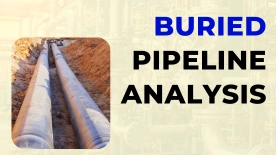
  • Stress engineers often lack knowledge of soil properties, which is essential for buried pipeline analysis. The buried module in software is usually known only for 'Data Entry'.
  • Overview of buried pipe behavior
  • Soil properties and their significance
  • CAESAR II buried module – Basic method and ALA method
  • Comparison between above two methods
  • Discussion on technical paper

  • Engineers should first conceptualize a solution mentally, model it accurately in software, and then compare results. This module teaches traditional methods of pipeline stress analysis before sophisticated software existed.
  • Pipeline Thickness Calculations as per ASME B31.4
  • Pipeline Thickness Calculations as per ASME B31.8
  • Pipeline thickness calculations for External Pressure
  • Buoyancy calculations
  • Anchor Force Calculations
  • Virtual anchor length calculation
  • Support Span Calculations

  • Stress Intensification Factor (SIF) is a complex and often least understood topic in pipe stress analysis. This course shares the key concepts and research insights.
  • What is flexibility factor
  • What is SIF
  • How to calculate it using appendix D of ASME B31.3
  • The limitations of ASME B31.3 appendix D
  • Markl's work in SIF
  • Overview of Finite Analysis method to get SIF
  • The myths and truths about SIF
  • How SIF is used in stress equations
  • Should we consider SIF in Sustained and occasional cases?
  • Mitre bends and its SIF
  • How flexibility of the bend changes with its connection to flanges
  • Discussing technical paper authored by the faculty

  • Flange leakage is a critical safety aspect. Though a complete guarantee is impossible, industry-approved practices help minimize leakage.
  • Pressure equivalent method and manual calculations
  • NC 3658 method manual calculations
  • Verifying CAESAR II results against hand calculations
  • Understanding the basics of why flange leaks occur and the required loop height
  • ASME Section VIII method input in CAESAR II
  • ASME Section VIII method manual calculations
  • Reference documents from flange leakage analysis
  • Supporting measures to avoid flange leakage

  • Mechanical engineering curriculum rarely covers earthquake or seismic events. When pipelines cross seismic zones, strain-based analysis due to seismic wave propagation is required.
  • Limitations of software to perform seismic analysis for buried pipeline
  • Basics about earthquake
  • Types of seismic waves
  • Boundary separation of tectonic plates
  • Fault types
  • Seismic wave propagation calculations

  • In addition to manual calculations, pipeline engineers perform advanced calculations due to limitations of beam element software and to avoid expensive FEA methods.
  • Pipeline penetration resistance calculations
  • Upheaval buckling calculations
  • Crossing (Road / Rail) calculations

  • A good pipeline engineer must be aware of potential hazards along the pipeline's route. While geo-specialists usually handle these, understanding them is important.
  • What is Geo-Hazard
  • Landslides
  • Soil Liquefaction
  • Lateral Spread
  • Fault / Fissures
  • Blasting
  • Water Hammer
  • Karst, Sink Holes

Certificate

Certificate

Know Your Trainer

MTech - VJTI (Mumbai) Chartered Engineer (C.Engg - IEI) Pipe Stress & Structural Dynamics Specialist

Meet Your Trainer:Gaurav Bhende

  • 22+ years of hardcore industrial design engineering and dynamic testing experience.
  • Actively involved in critical live industrial design validation and technical execution projects.
  • Leads and manages a high-performing global corporate team of 40+ engineering professionals.
  • Extremely experienced in navigating rigorous third-party compliance audits for international consultants.
  • Multi-year global award-winning professional and highly celebrated industry keynote speaker.
  • Specializes in bridging advanced software simulation modelling with real-world structural compliance.
  • Conducts comprehensive weekly live Q&A modules to solve active job queries for global workforces.
22+Years Industrial
Experience
2000+Professionals Trained
Online & Offline
30+Countries Professionals
Reached
40+Professionals
Led

Core Engineering & Design Expertise:

  • Piping Codes & Standards: Exceptional authority over international codes including ASME B31.1 (Power Piping), B31.3 (Process Piping), B31.4, B31.8, ISO 14692 (GRP/FRP Piping), EN 13480, and AS 2885.
  • Advanced Analysis & Analytics: Thorough comprehensive understanding of Pipe Stress Analysis, Pipe Support Analysis, Structural Design, FEA Reports, Hydraulic Reports, P&IDs, PV Elite Reports, and CFD Analysis.
  • Software Simulation Mastery: Elite hands-on expert and corporate trainer in industry-leading software suites like CAESAR II, ROHR II, and ANSYS.

Distinguished Career Highlights & Milestones:

  • Drivers of Success Global Champion: Awarded the prestigious First Prize consecutively in 2011 and 2012 in the globally celebrated "Drivers of Success" competition hosted by Intergraph.
  • HXGN Global Conference Speaker: Featured technical speaker at the HXGN 2013 Global Conference on the high-end topic "Effect of Modelling Supports with CII’s Structural Module on Static and Seismic Analysis".
  • CAU Express Official Presenter: Hand-picked as the elite official presenter for CAU Express across 2015, 2016, and 2017, anchoring advanced engineering symposiums across major industrial hubs.
  • International White Paper Author: Researched and presented breakthrough white papers in top-tier international engineering conferences, including official ASME technical conventions.


Free Videos

🎥 To Watch free Video lectures- Download Our App Now!

Click the link below to get started.

Reviews

Client

Sayali Jangam

Experience: 4 Years

L&T Hyrocarbon

It was a great experience during the Pressure Vessel Design training. I have gained very in-depth knowledge about all aspects of Design. It boosted my confidence and as a result the growth in my career has been significant.

Client

Belkacem Kisri

Experience: 5 Years

Bilfinger LTM Industrie SAS

This course is very good. In-depth knowledge about ASME code and Pressure Vessel, Heat Exchanger design & Nozzle Pro FEA. All the concepts are deeply explained. It has helped me enhance my knowledge and confidence.

Client

Elmigdad Omer

Experience: 4 Years

Doha Petroleum Construction Co. Ltd.

My thanks and appreciation to Mr. Sachin Pol for sharing his experience and his effort to make this course effective with technical knowledge and good engineering practices. A great learning experience!

Client

Raghuraman R

Experience: 17 Years

Technip Energies

This is the easiest and quickest way to learn the Code and static design. Very simplified method to make the concepts clear. Calculations are explained in very much detail.

Client

Mangesh Deshmukh

Experience: 14 Years

Toyo

Trainer is technically very perfect and is even a better mentor. The training Program is very organized and cleared all my doubts about static design. Even minute details are taken care of.

Client

Swati Bote

Experience: 10 Years

Worley

I have developed a thorough understanding about the various code requirements and calculations after doing this course. My approach towards Design has become more practical.

Client

Priyanka Burhanpure

Experience: 13 Years

Thermax Ltd.

The content of the course is well-organized and covers all the concepts, code requirements and manual calculations which you need very badly as a Design Engineer. I found this as the only course where you can ask your live project queries.

Client

Arvind Surve

Experience: 22 Years

Alfa Laval

The Quality of teaching is simply excellent! Highly explanatory animations for better understanding, which has made all the concepts very clear.

Client

Mauli Khandekar

Experience: 11 Years

GSEC

The ASME code is difficult to understand and interpret, but the Trainer has made it simple and interesting. The only course in which manual design calculations/problems are taught in-depth.

Client

Nikita Nimbalkar

Experience: 5 Years

TechInt

This is one of the best courses for Static Equipment Design Engineers. It's well-structured, easy to follow, and covers everything—from detailed explanations to manual calculations. A truly comprehensive and valuable course.

Client

Umesh Kulkarni

Experience: 25 Years

Thermax

A very good course. Detailed explanation about the basic concepts. I have gained a lot of knowledge of Pressure Vessel and Heat Exchanger Design. I would definitely recommend this course.

Client

Bhavik Modi

Experience: 10 Years

HLE Glascoat Ltd.

Great learning and experience. Their mentorship has really helped me to enhance my knowledge. This is such a comprehensive online platform for Static Equipment Engineers with manual calculations & Live Q&A sessions.

Client

Brahmananda Mohapatra

Experience: 14 Years

Shreno Engineering Ltd.

I have very much benefited from Live Q&A session as I was able to get the answers to my project queries. It has boosted my confidence and as a result I have successfully faced ASME U-stamp Audit. This training has really transformed my career.


Client

Harshil Thakarar

Experience: 2.5 Years

Meinhardt Group

I have very much benefited from Live Q&A session as I was able to get the answers to my project queries. It has boosted my confidence and as a result I have successfully faced ASME U-stamp Audit. This training has really transformed my career.

Loading similar courses...