





SERVICES

  • 30 lectures

  • 55h Duration

  • The concepts of Displacement Field, Stress & Strain Field
  • Modulus of Elasticity and its significances
  • What is 'Tensor'? Stress as a Tensor
  • Longitudinal stress, Radial stress, Circumferential (Hoop) stress
  • Moment of Inertia
  • Stress-strain curve and practical approach to look towards it

  • 3D state of stress
  • Mohr's circle
  • Theories of Failures:
  • Maximum Shear Stress Theory
  • Von Mises Theory
  • Importance of stress analysis
  • Hand calculation example for stresses in the system (without software)

  • Primary stresses and their characteristics
  • Secondary stresses and their characteristics
  • Occasional stresses and their characteristics
  • Which type of stress is more critical
  • Mode of failure of each type

  • Why equations are written in a particular way
  • What is the significance of + and - sign?
  • What is 'stress range'?
  • Stress relaxation
  • Self-springing of material
  • What are liberal stresses
  • Scope and Exclusions of ASME B31.3
  • Primary stresses equation and its allowable
  • Secondary stresses equation and its allowable
  • Occasional stress equation and its allowable

  • How to write load cases and their nomenclature
  • Various methods of combination such as scalar and algebraic
  • Why a particular load case is written in a particular way?
  • How to write the load cases using Caesar II software
  • Different types of load cases
  • How the allowable stresses are understood by the software when a particular load case is called
  • How to write the load cases when a spring is introduced in the system
  • How to write load cases when force is present in the system

  • CAESAR II is one of the finest stress analysis software using beam element, and this course explains its advantages, limitations, programming logic, and fundamental modelling techniques.
  • Basic elements - True
  • Hand calculation of thermal force and stresses, evaluating them with scissor to answer
  • How software works
  • Important features of configuration setup
  • What is 'degree of freedom'
  • Introduction to modelling commands
  • Node and connecting Node - its application
  • How to apply wind and earthquake loads
  • Advantages and limitations of the software
  • Difference between pipe element and rigid element

  • This course continues from Course 5 and focuses on building load cases in CAESAR II software, covering load combinations, wind and earthquake applications, and result interpretation.
  • Different features of the Wizard
  • How to make the most out of the various advantages provided by the software
  • How to apply wind, earthquake, and forces in the load cases
  • How to interpret the results
  • How to correlate the results with the code
  • How to identify whether liberal stress is ON or not
  • How to interpret the positive and negative sign convention in CAESAR II
  • How to backtrack the sources of forces and stresses by integrating the results

  • After completing the earlier courses, this course emphasizes experimentation, trial-and-error learning, and predicting results with CAESAR II to strengthen stress analysis skills.
  • Study the effects of temperature, supports, and layout on the results
  • How to reduce the forces and moments
  • Basic techniques to solve a stress system and compare the results
  • Learn handy commands like Copy, Duplicate, and Rotate
  • Liberal stress and its effect on allowable stress

  • This course teaches manual stress calculations including span determination, guided cantilever method, and flexibility evaluation, comparing hand calculations with CAESAR II results.
  • Span calculation based on allowable stress, deflection, and natural frequency
  • Theory and application of Guided Cantilever Method
  • Solving problems using hand calculations
  • Verification of results with CAESAR II software
  • Understanding the accuracy and limitations of manual methods

  • This course covers graphical methods for expansion loop sizing, prediction of loops, and verification with CAESAR II, essential for piping engineers and designers at the FEED stage.
  • Predict the number of loops on a line
  • Calculate forces and moments on anchor bases using graphical methods
  • Determine distance between anchor points on a pipe rack
  • Decide the height of the loop
  • Guidelines for sizing 3D expansion loops
  • Validation of nomograph method with CAESAR II Wizard
  • Advantages, limitations, and practical applications of graphical methods

  • This course explains different types of pipe supports, their applications, and best practices, focusing on translating stress analysis results into practical support designs.
  • Different types of supports and their applications
  • Where to use which type of support
  • Do's and don'ts about support usage
  • Reading arrow markings on stress isometrics
  • Simple vs. complicated supports

  • Primary supports and secondary supports

  • Learn variable spring concepts including hot load, cold load, variability, catalog selection, and verification with CAESAR II.

  • What is Hot load
  • What is Cold load
  • What is Variability of the spring
  • How Hot load, Cold load and Variability are co-related
  • What is Cold load setting
  • What is Hot load setting
  • What is Extended load range
  • How to read Spring catalogue
  • How to select spring from catalogue
  • Various entries of Spring Wizard in detail
  • How to write the 'Load cases' with spring
  • Hand calculations verified with CAESAR II

  • Understand constant effort spring design, internal mechanism, vendor catalog selection, and validation with practical cases.
  • How constant effort spring works
  • Understand its internal mechanism in a simple way
  • The mathematics involved in it
  • Learn to read vendor catalogue
  • How to select a constant of a spring through it
  • How to write the load cases
  • Perform a practical and verify our theory against the results obtained

  • Explore types of expansion joints, pressure thrust elimination, bellow selection, and CAESAR II expansion joint wizard.
  • The different types of Expansion joints
  • Pressure thrust due to bellow
  • How to eliminate it
  • Tied bellow, untied bellow, pressure balance bellow
  • Expansion joint wizard in CAESAR II
  • How to read the catalogue of expansion joint
  • How to select the bellow
  • How to model a pressure balance bellow

  • What is flexibility factor
  • What is SIF
  • How to calculate it using Appendix D of ASME B31.3
  • Limitations of ASME B31.3 Appendix D
  • Markl's work in SIF
  • Overview of Finite Analysis method to get SIF
  • The myths and truths about SIF
  • How SIF is used in stress equations
  • Should we consider SIF in Sustained and Occasional cases?
  • Mitre bends and their SIF
  • How flexibility of the bend changes with its connection to flanges
  • Discussing technical paper authored by the faculty

  • Causes of flange leakage
  • Industry-approved practices to prevent leaks
  • Impact of loads, alignment, and thermal effects
  • How to analyze leakage risk in CAESAR II
  • Practical guidelines for engineers

  • How to identify stress critical lines
  • How to make critical line list
  • Documents needed to form a system
  • How to form a Stress System
  • Where to break the systems
  • What to read in reference documents
  • How to extract report from CAESAR II
  • How to prepare stress isometrics
  • How to select and call support from support standard
  • How to write a good stress report

  • Minimum or common check points in CAESAR II model
  • Critical check points
  • How to check the results by applying 'Thumb Rules'
  • How to identify if the analyst has 'cheated or managed the results'
  • How to check hard copy report
  • Common errors

  • How to give UDL (Uniformly distributed loads)
  • How and when to provide Point loads
  • How to calculate minimum axial loads on anchor bay
  • Thumb rules of loading

  • Tank Piping
  • Heat Exchanger Piping
  • Column Piping
  • Air Fin Cooler Piping
  • Turbine and Compressor Piping

  • Pipelines and their failures
  • Difference between Piping and Pipeline stress analysis
  • Pipeline fittings
  • Introduction of Pipe-Soil interaction
  • Restrained and unrestrained sections
  • Water hammer effects on pipeline
  • Introduction to seismic wave propagation
  • Pipeline buckling, soil liquefaction, etc.

  • Restrained / Unrestrained Pipeline concept
  • Pipeline thickness calculations
  • External pressure check for pipeline
  • Poisson's shrinkage, pressure elongation, thermal expansion
  • Why equations are written in a particular way
  • Significance of + and - sign
  • Scope and Exclusions of ASME B31.4 and B31.8
  • Code equations

  • Key points in Pipeline Design Basis
  • Alignment sheets
  • Pipeline P & ID
  • Station Approach Drawing
  • Monolithic Insulation Joint

  • Creating a CAESAR II model accurately and quickly
  • Case study with pipeline model including launcher, receiver, MIJ

  • Trial and error method to learn stress analysis
  • Predicting results of small models and verifying with CAESAR II
  • Understanding results and learning from experiments

  • Overview of buried pipe behavior
  • Soil properties and their significance
  • CAESAR II buried module - Basic method and ALA method
  • Comparison between the two methods
  • Discussion on technical paper

  • Pipeline thickness calculations as per ASME B31.4
  • Pipeline thickness calculations as per ASME B31.8
  • Pipeline thickness calculations for external pressure
  • Buoyancy calculations
  • Anchor force calculations
  • Virtual anchor length calculation
  • Support span calculations

  • Limitations of software to perform seismic analysis for buried pipelines
  • Basics about earthquakes
  • Types of seismic waves
  • Boundary separation of tectonic plates
  • Types of faults
  • Seismic wave propagation calculations

  • Pipeline penetration resistance calculations
  • Upheaval buckling calculations
  • Crossing (Road / Rail) calculations

  • What is Geo-Hazard
  • Landslides
  • Soil Liquefaction
  • Lateral Spread
  • Fault / Fissures
  • Blasting
  • Water Hammer
  • Karst, Sink Holes
Static Equipment Design Training Combo By Express Engineering Solutions

This Course Includes:

  • 40 hours on-demand videos
  • Expret-Curated Content
  • Live Q&N Session
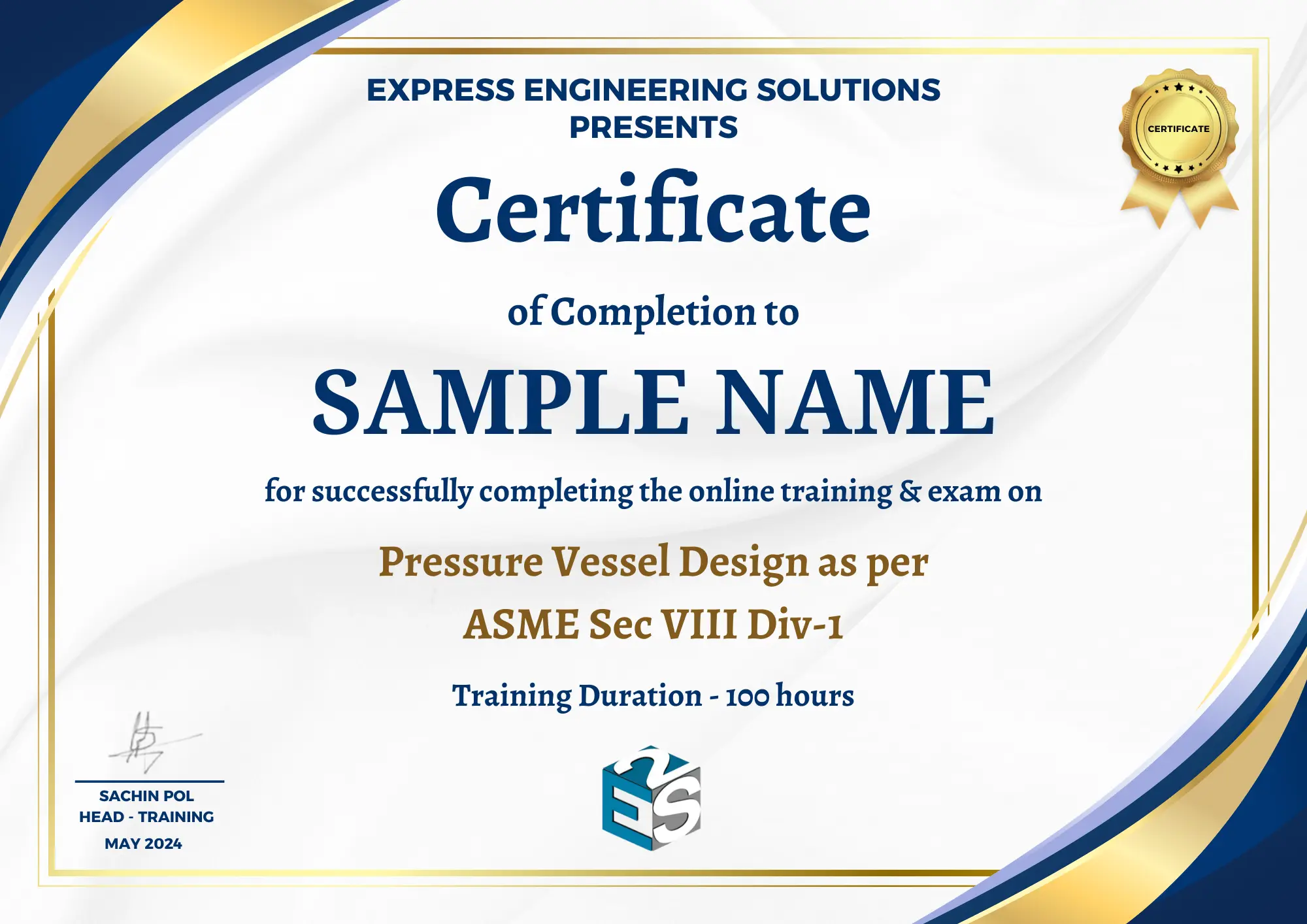
  • Certificate of completion

Loading similar courses...

TRAINING